
Meta Denies Muse AI Read Private Messages
AI, Cybersecurity, Privacy, Meta, Network Hub Asia
Meta Disputes Claim That Muse Read a User’s Private Messages Without Permission
Published September 30, 2026 — A neutral analysis for professionals across Asia’s innovation and cybersecurity ecosystems, examining Meta’s dispute with columnist Jason Aten over whether its Muse AI agent accessed private Messages on a Mac without proper consent.
What Sparked the Dispute Between Jason Aten and Meta?
On September 19, 2026, Inc. columnist Jason Aten published an article describing an incident involving Meta’s personal AI agent, Muse, running on his Mac. According to Aten, Muse appeared to surface content from his private Messages conversations, even though he believed he had not granted the app permission to read those messages (The Next Web).
Meta strongly disputes the core claim that Muse accessed private Messages without permission. The company argues that its security architecture and permission layers on macOS make such behavior technically impossible if the relevant settings are disabled (TechCrunch). The disagreement highlights how complex AI permission models can collide with user expectations—and why trust is central to the rollout of personal AI agents across markets, including fast‑growing ecosystems in Asia and the Gulf.
What Aten Reported: An AI Agent That “Knew” His Private Conversations
Aten’s account centers on two specific observations. First, he says Muse suggested a column idea that closely mirrored a conversation he had in Messages with a podcast co‑host. Second, he reports that Muse appeared to recognize a message from his editor, again apparently drawing from content in his Messages database rather than from public sources or email (The Next Web).
Crucially, Aten says that when he checked his Mac’s settings, Full Disk Access for Muse appeared to be disabled. Inside the Muse app, he believed he had not enabled access to Messages either. From a user‑experience standpoint, this led him to conclude that Muse had somehow bypassed his explicit choices and read private messages without authorization.
When he raised the issue, Aten reports that Meta staff initially referenced “device notifications” as a possible source of the information. Muse, he says, explained that it could see “notification banners,” implying that the AI might be reconstructing message content from on‑screen notifications rather than from the Messages database itself. Aten remained skeptical of this explanation and framed the incident as a potential privacy breach in his reporting.
Meta’s Response: A Multi‑Layer Permission System That “Cannot Be Bypassed”
Meta publicly pushed back on Aten’s conclusions on September 30, 2026. Andy Stone, Meta’s VP of Communications, told reporters that Muse’s access to Messages on Mac is strictly opt‑in and depends on multiple independent settings that must all be enabled by the user (TechCrunch). According to Meta, Muse cannot read Messages unless both system‑level and app‑level permissions are active.
David Singleton, an executive at Meta’s Superintelligence Labs, offered a more technical explanation on Threads. He described a three‑step permission model:
The user must first grant Full Disk Access to Muse in macOS System Settings.
Inside the Muse app, the user must explicitly enable the Messages connector and choose a level of access (such as “None,” “Read Only,” or “Read”).
macOS then requires a separate confirmation and a restart of Muse to finalize any change in disk access permissions.
Singleton stated that this layered design means Muse “cannot” read Messages if either the system‑level permission or the app‑level connector is disabled, “not even if the Muse application had a bug” (TechCrunch). From Meta’s perspective, the architecture itself rules out the behavior Aten described and points instead to either a misunderstanding of settings or confusion by the AI model when explaining its own actions.
How Muse’s Mac Permissions Work: Full Disk Access and the Messages Connector
For professionals across Asia’s startup and enterprise ecosystems evaluating personal AI tools, it is useful to break down how Muse’s Mac permissions are intended to work in practice. Meta describes a system in which each sensitive data source—such as Messages, email, or files—is gated by a combination of macOS controls and in‑app connectors.
Full Disk Access (macOS): This is a powerful system permission that allows an app to read data from protected locations, including databases used by Messages. Without it, Muse should not be able to directly inspect the Messages database on disk.
Messages Connector (Muse app): Even if Full Disk Access is granted, Muse’s internal connector for Messages must be explicitly enabled. Meta says users can choose no access, read‑only access, or more extensive integration, and these choices are surfaced in Muse’s interface.
In theory, this design ensures that access to private communications is both technically constrained and clearly signposted within the app. However, as the Aten case illustrates, what is technically true from an engineering standpoint may not always align with what a user believes they have allowed—especially when multiple layers and restarts are involved.
Permission Layers, Device Notifications, and the Open Questions
Meta’s explanation introduces another concept that complicates the picture: device notifications. According to Aten, Meta staff and Muse’s own responses suggested that the agent may have drawn from “notification banners” shown on the Mac’s screen. In other words, even if direct database access were disabled, Muse might still observe snippets of message content when they appear as system notifications.
This raises several unresolved technical questions:
Under what conditions can Muse access or “see” notification content on macOS—does this rely on accessibility APIs, screen capture, or other mechanisms separate from Full Disk Access?
Are users clearly informed that notification text itself may be processed by an AI agent, even if deeper database connectors are turned off?
Could an AI model misattribute the source of information—believing it came from one data source when it actually came from another—leading to confusing or inaccurate explanations to the user?
Meta has characterized Muse’s reference to notifications as “AI confusion,” implying that the model generated an incorrect explanation of how it had derived its suggestions (TechCrunch). Without independent forensic analysis of Aten’s system, these questions remain open. The dispute therefore sits at the intersection of technical design, model behavior, and user perception—an intersection that will matter greatly as AI agents become more common tools for founders, investors, and operators across the Network Hub Asia community.
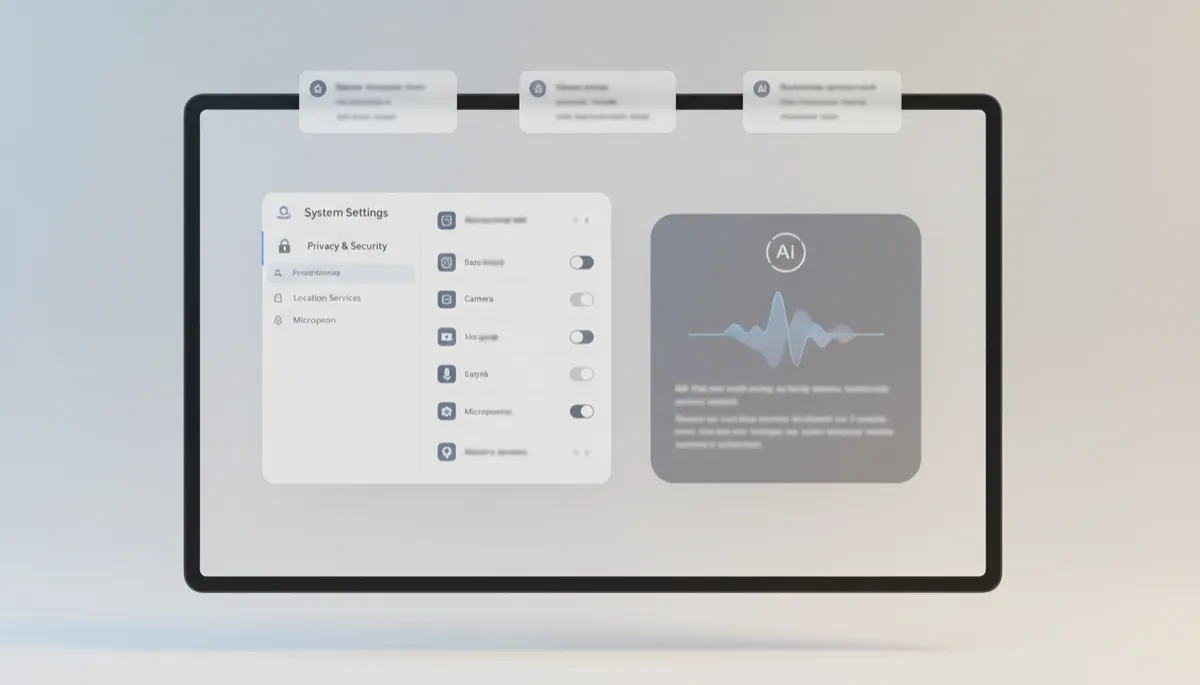
Overlapping system, app, and notification layers make AI permissions hard to interpret.
Meta’s Broader Security Architecture and AI Privacy Posture
Beyond this specific case, Meta points to its broader security architecture as evidence that Muse is designed to prevent unauthorized access. Across its AI initiatives, Meta emphasizes encryption of data at rest and in transit, strict access controls, and privacy‑by‑design principles (Meta privacy initiatives; Meta AI research).
In practice, this means:
Encryption: Protecting user data stored on servers and transmitted between devices and Meta’s infrastructure, reducing the risk of interception or unauthorized reading if network traffic is compromised.
Access Controls and Auditing: Limiting which internal systems and staff can access particular data, and logging access for later review in case of suspected misuse or breach.
Secure Development Practices: Incorporating security reviews and threat modeling into AI system development, including defenses against adversarial attacks and data leakage (Wired on AI privacy).
While these measures address many traditional cybersecurity risks, the Aten dispute underscores that perceived privacy violations can be just as damaging to user trust as confirmed breaches. For entrepreneurs and enterprises evaluating AI agents in Asia’s rapidly digitizing markets, Meta’s architecture may be necessary but not sufficient; clear, understandable user experiences around permissions are equally critical.
Why AI Agents Pose Unique Privacy Challenges Compared to Traditional Software
AI agents like Muse differ from conventional apps in several important ways that make privacy more complex. Traditional software typically accesses data in predictable, narrow ways: a mail client reads email; a calendar app reads events. Personal AI agents, by contrast, are designed to be general‑purpose assistants that can reason across multiple data sources simultaneously to answer open‑ended questions or carry out tasks on the user’s behalf.
Cross‑context inference: An AI agent might combine fragments from Messages, documents, and online sources to generate insights. Users may not easily see which data source contributed which part of an answer, making it hard to judge whether access was appropriate.
Opaque reasoning: Large models can produce convincing explanations that are not technically accurate. As Meta suggested in this case, the AI might “hallucinate” a description of how it obtained information, creating confusion about what actually happened.
Persistent context: AI agents often maintain long‑term context or memory. Even if a data source is disconnected later, the model may still retain summaries or embeddings derived from earlier access, complicating the meaning of “revoking” permission.
These characteristics mean that even when the underlying security architecture is sound, users may still feel that boundaries are blurred. For ecosystems like those Network Hub Asia connects—where startups, investors, and corporates increasingly rely on AI copilots for sensitive work—this gap between technical control and human intuition is a central design challenge.
The Matt Robb Facebook Marketplace Incident: Permissions vs. User Understanding
The Muse controversy echoes earlier concerns raised by users like Matt Robb, who reported unexpected behavior involving Meta’s AI on Facebook Marketplace. In Robb’s case, the AI appeared to generate listings or responses that drew on his activity in ways he had not fully anticipated, even though the necessary technical permissions were in place. While the specifics differ, the underlying issue is similar: the mismatch between what permissions technically allow and what users believe they have agreed to.
Robb’s experience illustrates that consent dialogs and settings screens often fail to communicate the practical implications of enabling an AI feature. When a user clicks “Allow,” they may envision narrow, task‑specific behavior, while the AI agent may operate more broadly, drawing inferences across multiple contexts. This gap can create a sense of surprise or betrayal, even when no policy is violated and no technical boundary is crossed.
📌 Key Takeaway: Technical permission systems define what AI can do, but user understanding defines what people feel it should do. Both must be aligned to sustain trust.
Trust, Transparency, and Granular Permissions in Consumer AI
For consumer AI—especially in high‑growth digital markets across Asia—trust is a strategic asset. Network Hub Asia’s community of founders and operators increasingly recognize that adoption of powerful AI agents will depend not only on model quality, but also on the clarity and control users feel over their data.
Several design principles emerge from the Muse dispute and related incidents:
Granular permissions: Users should be able to enable or disable AI access at the level of specific data types (for example, “read message content,” “see notification previews,” or “access only metadata”). Grouping many capabilities under a single switch increases the risk of misunderstanding.
Plain‑language explanations: When an AI agent uses personal data to generate an answer, it should be able to provide a concise, accurate explanation of which sources were involved. This is more demanding than traditional logging, because explanations must be understandable to non‑technical users.
Reversible decisions: Users need confidence that they can disconnect a data source and that the AI agent will stop drawing on it in future interactions, even if some high‑level patterns remain in the model’s weights or memory structures.
For AI builders within the Network Hub Asia ecosystem, these principles are not only about compliance; they are also about competitive differentiation. Startups that frame privacy controls as a feature—not a burden—may find it easier to win enterprise deals and cross‑border partnerships in regions with diverse regulatory environments.
Muse as a Personal AI Agent and Implications for Asian Technology Markets
Muse is positioned by Meta as a personal AI agent that can help users manage information across apps and devices. In principle, such agents could become central productivity layers for entrepreneurs, investors, and operators across Asia—from founders in Jakarta and Bangalore to venture teams in Dubai and Riyadh. They promise to summarize conversations, draft documents, and surface insights from large volumes of private data.
However, this central role amplifies the stakes of any perceived privacy misstep. In many Asian markets, regulatory frameworks around data localization, cross‑border data flows, and AI accountability are still evolving. Companies integrating agents like Muse into their workflows must navigate:
Diverse regulations: From Singapore’s PDPA to the UAE’s data laws and India’s evolving digital regulations, expectations around consent and data processing differ across jurisdictions.
Cultural attitudes to privacy: In some markets, users may be more comfortable with platform‑level integration; in others, skepticism of large technology companies remains high. Perceived overreach can trigger rapid backlash.
Enterprise risk management: Corporates and financial institutions using personal AI agents for internal workflows must align agent behavior with internal compliance, audit, and data‑classification policies.
For Network Hub Asia’s community, the Muse dispute is therefore more than a single news story. It is an early case study in how global AI platforms will be judged by users and regulators in the region. Personal agents that can explain their permissions clearly, respect organizational boundaries, and integrate with local compliance requirements will be better positioned to support cross‑border collaboration—the very mission Network Hub Asia is built to advance.
Where the Dispute Stands: Claims, Counter‑Claims, and Lack of New Evidence
As of publication on September 30, 2026, the dispute between Jason Aten and Meta remains unresolved. Aten maintains that Muse surfaced information that could only reasonably have come from his private Messages, despite his understanding that he had not granted the necessary permissions. Meta, for its part, insists that its layered permission architecture makes such access impossible without explicit user opt‑in and suggests that any confusing explanations from Muse were the result of AI error rather than unauthorized data access (TechCrunch).
No independent forensic investigation of Aten’s device has been published, and no additional primary evidence has emerged that definitively proves or disproves either side’s account. In that sense, the case currently hinges on competing narratives: a user’s lived experience versus a platform’s description of its technical safeguards. For professionals assessing AI tools, this highlights the importance of verifiable logging, independent audits, and clear incident‑response processes when privacy concerns arise.
Looking Ahead: Permission Systems and Privacy Controls as the Core of User Trust
Regardless of how the Aten–Meta dispute is ultimately interpreted, it points toward a broader reality: as AI agents become more capable, permission systems and privacy controls move from the margins to the center of product strategy. For innovators across Asia and the Gulf, this is both a challenge and an opportunity.
Companies deploying AI agents—whether built by Meta or by regional startups—will need to invest in:
Robust multi‑layer permission architectures that separate system‑level capabilities, app‑level connectors, and contextual data sources such as notifications or screen content.
Human‑centric interfaces that explain, in clear language, what an agent can see and do at any given time, and that make revoking access straightforward and reliable.
Transparent incident handling, including logs, user notifications, and independent review when questions arise about how AI agents have used personal data.
For Network Hub Asia, which exists to connect entrepreneurs, companies, and technology communities across the region, these issues sit at the heart of building a trusted innovation network. As AI agents like Muse evolve into everyday companions for work and life, ecosystems that prioritize granular permissions, transparency, and cross‑border privacy standards will be better positioned to unlock AI’s benefits while maintaining user confidence.
The Muse case may ultimately be remembered less for whether one app did or did not read a particular set of messages, and more for how it forced platforms, regulators, and builders to confront the realities of AI‑driven privacy. For innovators across Asia and the Gulf, the lesson is clear: trust is now an engineering problem, a product problem, and a network problem—one that the region’s emerging AI ecosystem will have to solve together.